
How to Check for a Warrant in Charlotte Court House
Use the town website for town services, calendar dates, and contact details. It does not show a separate police warrant desk or municipal criminal court. For a case, start with the court name and case number printed on the person’s own notice, then contact the court clerk.
- Check the town office site for municipal-service contact information only.
- Read the issuing court, case number, and hearing date on the court paper.
- Use the court’s official search if the case is a public adult matter.
- Call the clerk if the result is absent, stale, or unclear.
- Ask counsel about appearance or recall steps before traveling.
Charlotte Court House Town Hall
The town office is at 350 George Washington Highway, P.O. Box 246, Charlotte Court House, VA 23923. The town lists office hours Monday through Thursday from 9:00 a.m. to 1:00 p.m. and a phone number of 434-542-5781. Check the live contact page before visiting because local hours can change.
The town’s calendar and municipal-building references concern town government. They are not a criminal court docket or a warrant-status service.
The official Charlotte Court House town site provides local office and calendar information.
Charlotte Court House Police and Court Warrants
The reviewed town site does not identify a separate police department, municipal court, or public warrant portal. The county plan says Charlotte Court House had no police officers in its reference period. That fact explains why the town office should not be treated as a law-enforcement records desk.
When a paper has Charlotte Court House as the place but names another court as issuer, follow the issuing court. Town meetings, permits, and calendars do not reveal whether a resident has a court process.
Charlotte Court House Warrant History
The courthouse is a visible landmark in town, but it is not a single all-purpose records counter. The county plan describes the historic courthouse as built in 1822–23, with plans attributed to Thomas Jefferson. Today, Circuit, General District, and Juvenile and Domestic Relations functions share the court address while keeping different records.
That history helps explain the town’s courthouse identity. It does not establish where a specific case is filed or whether a warrant is current.
The Census incorporated-place table supplies the town’s population vintage.
Types of Charlotte Court House Warrants
Residents may encounter a traffic case, misdemeanor process, felony indictment, or protected JDR matter. The town does not publish a separate local criminal docket. The court named on the paper decides whether the process is a summons, warrant, capias, or another order.
| Warrant Type | How It Arises | Who Issues It |
|---|---|---|
| Traffic process | Summons, court date, or statutory nonappearance action | Issuing court named on the paper |
| Bench warrant / capias | Missed hearing or a court order | Judge or court handling the case |
| Arrest warrant | Sworn complaint and probable-cause review | Magistrate or authorized judge |
| JDR process | Juvenile, support, or family matter | Protected JDR clerk route |
Charlotte Court House Clerk Routes
The courthouse address serves three court functions, but each clerk handles a separate case set. A Circuit felony question is not settled by the GDC traffic search; a JDR question may be restricted even when a name is known. The building’s shared location makes checking the court label especially useful.
The Virginia court directory and local pages list the relevant clerks. Use the exact court printed on the notice, not only the town name at the top of the envelope.
What a Charlotte Court House Warrant Record Shows
No town-specific warrant schema was found. A court file may show a case number, offense, issuing authority, date, hearing, and service or process information when entered. Some material may be omitted or restricted. Ask the clerk how to read the entry before relying on a short online label.
| Warrant / Cause Number | No town-specific warrant-number format was published; use the number printed on the court paper. |
|---|---|
| Case / process number | Number on the court paper; no local format was published. |
| Person / offense | Check the name and exact offense text in the court file. |
| Issuing court | Circuit, GDC, or JDR as printed on the case. |
| Next hearing | Confirm the date and any later order with the clerk. |
| Bond / status | Ask the court or magistrate about current terms. |
Charlotte Court House Warrant Building Map
Town hall and the county justice buildings are distinct. The town office is on George Washington Highway. The courts are on David Bruce Avenue, while the Sheriff’s Office and jail are on Law Lane. Verify the destination before leaving; a town calendar or a courthouse landmark does not identify the office that holds a case.
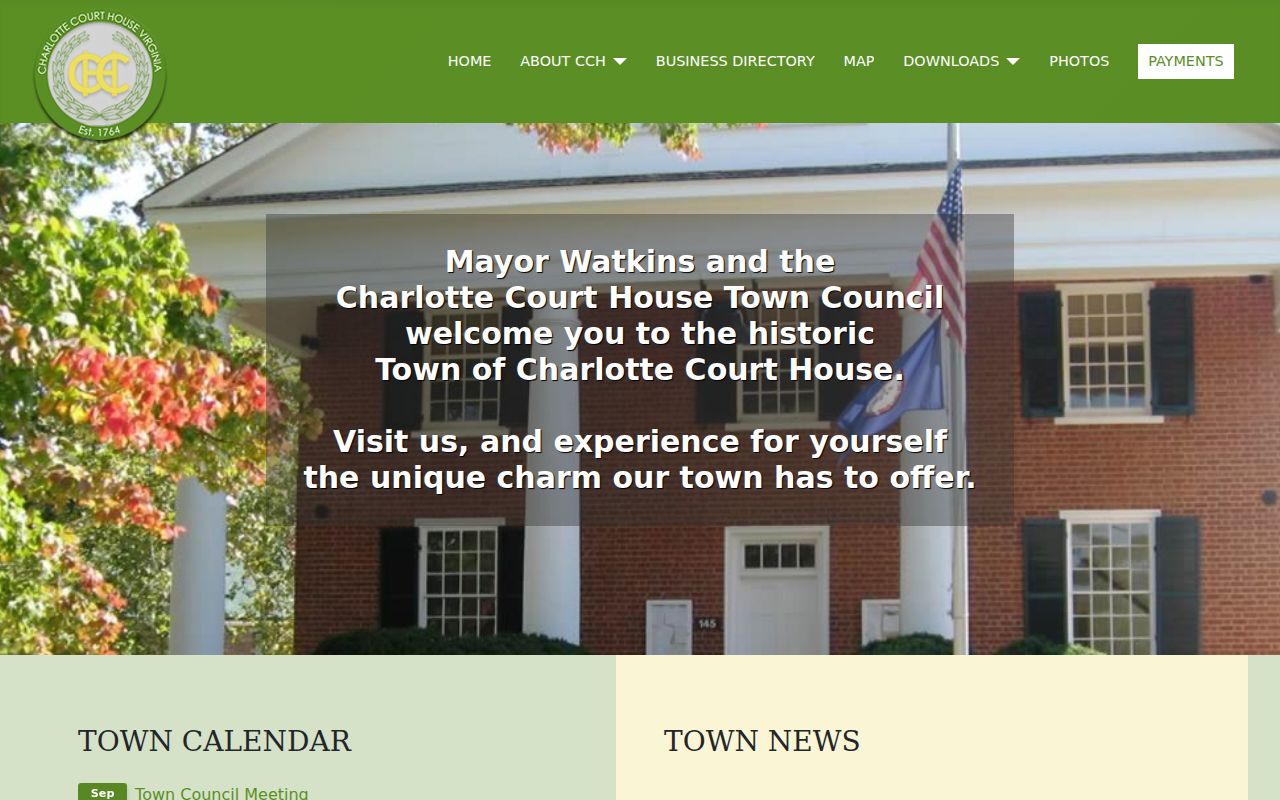
The official town screenshot below shows local municipal information, not a wanted-person listing or court search result:
Check the current court and Sheriff pages for access and security instructions.
Where Charlotte Court House Warrants Fit With Charlotte County
For a case arising in Charlotte Court House, the issuing clerk is the countywide route: Circuit at 434-542-5147 for felony and indictment records, GDC at 434-542-5600 for many adult traffic and misdemeanor cases, or JDR at 434-542-5104 for protected family and juvenile matters; the Sheriff’s main number is 434-542-5141 for service and enforcement questions. The Virginia case system is only a limited public index. Use the Charlotte County warrant records overview for the full court map.
Charlotte Court House Warrant Visit Checks
The public court pages list office hours, but do not provide a universal warrant-clearing window. The Sheriff’s jail page lists visitation rules, including restrictions on phones and recording devices; those rules apply to visitors and do not establish a surrender procedure.
Call the office named on the case before going in. Ask about current hours, the right entrance, identification, and whether counsel should arrange an appearance.
Public Access to Charlotte Court House Warrant Records
Town records and court case files follow different request routes. Virginia FOIA applies to many agency records, subject to exemptions. Court case requests go to the clerk, and juvenile or sealed information may be withheld. Ask for any releasable part and the reason for a restriction.
Key Rules:
Virginia Freedom of Information Act - agency records may be requested, subject to exemptions.
Va. Code §17.1-208 - court case access is handled through the appropriate clerk.
Va. Code §16.1-301 - juvenile law-enforcement records have special limits.
Charlotte Court House Warrant Scam Checks
Because the courthouse is a familiar local landmark, an unsolicited payment demand may sound plausible. Virginia Courts warns against callers who claim immediate payment is needed to avoid arrest. Hang up and independently call the number published on the official court site.
Do not send a gift card, wire transfer, or cryptocurrency to clear a warrant. The issuing court can explain approved payment methods and what an actual payment changes.