
How to Check for a Warrant in Charlotte County
Begin with the court named on whatever paper you hold: a ticket, summons, or notice. Charlotte General District Court handles many adult traffic and misdemeanor cases in Charlotte County, while Circuit Court keeps felony and indictment files. The Sheriff's Office is the county's law-enforcement route for service questions, though its public site offers no complete warrant search and no dedicated warrant phone line. When you call, have the full name used in the case ready, plus an approximate birth date, the case or citation number, and any hearing date. Keep those details private until you know who needs them. If a result appears, ask the issuing clerk what process is active and what the lawful next step is. A family member should get the person's permission first, especially before contacting JDR about a protected matter.
- Select Charlotte GDC in the official online case system and search by name, case number, or hearing date.
- Call the matching clerk to confirm whether the docket shows a warrant, capias, summons, or another entry.
- Use Circuit Court for an indictment or felony capias, and JDR for juvenile or family matters.
- Call the Sheriff’s main office for enforcement routing. It is not a published warrant desk.
- If process may be active, speak with counsel and ask the court about appearance, recall, or bond steps.
Charlotte County Warrant Search Fields
The Virginia General District Court search opens with a court selector, so choose Charlotte before anything else. From there, its landing page offers party name, case number, and hearing date as search options. It documents no warrant-number field, no date-of-birth filter, and no rule for partial names. Don't assume those controls exist in a Charlotte County search.
| Search item | What to enter | Use |
|---|---|---|
| Court | Charlotte General District | Limits the search to the correct locality. |
| Party name | Name as shown on case papers | Check spelling and likely name variants. |
| Case number | Number from a summons or order | Best locator when available. |
| Hearing date | Date shown on the notice | Use to locate a scheduled event. |
Before you search, the Virginia GDC court selector shows the locality-first setup you'll use to reach Charlotte County. The state case-information page explains what the adult case system covers and where its limits sit.
Types of Warrants in Charlotte County
Virginia courts can issue a warrant, summons, capias, or show-cause process, depending on the event and the statute. The label on the actual paper matters more than any shorthand. Traffic and misdemeanor questions usually start with GDC in Charlotte County, felony indictment process with Circuit, and juvenile or domestic-relations matters with JDR.
| Process | How it may arise | Likely Charlotte route |
|---|---|---|
| Arrest warrant | Sworn complaint and probable-cause review | Magistrate, court, Sheriff |
| Bench warrant or capias | Missed appearance or court order | Issuing clerk and Sheriff |
| Search warrant | Judicial authorization to search | Issuing court or agency |
| Capias after indictment | Felony case advancing in court | Charlotte Circuit Court |
Charlotte County Warrant Service Counts
A service count can tell you about workload, but it cannot tell you whether one particular warrant is still open. The Sheriff's 2021 annual report counted 646 warrants served during that reporting year in Charlotte County. That number reflects service activity only, not unique people, not new warrants issued, and not today's outstanding inventory.
The Sheriff's 2021 annual report is where that dated figure comes from. Charlotte County publishes no public dashboard with a current active-warrant count, so no present total is stated here.
What a Charlotte County Warrant Record Shows
A court record can tie a piece of process to a case, the issuing court, the alleged offense, and the next event. Virginia's blank DC-311 complaint form shows the kinds of fields involved: identity, offense date and place, sworn facts, complainant, and issuing authority. A Charlotte County docket open to the public may show fewer details, and sensitive items can be withheld or redacted.
| Case or process number | Use the number printed on the summons or court order; no local warrant-number format was published. |
|---|---|
| Person and offense | Compare the name with the case papers and read the exact offense label. |
| Issuing court | Charlotte GDC, Circuit, or JDR determines which clerk can confirm the file. |
| Hearing or return date | Shows the next listed court event, if entered in the public case system. |
| Bond and status | Confirm current terms and whether process is served, recalled, or still open with the clerk. |
For the field layout only, the blank Virginia DC-311 form is a clear example. Never post a private person's form or identifying details online.
Charlotte County Warrant Records: Two Addresses
Two addresses matter here. The courts sit at 115 David Bruce Avenue, while the Sheriff's Office and the adjacent jail are at 222 Law Lane. These offices do different jobs in Charlotte County: court clerks keep case records and answer docket questions, and the Sheriff handles county law enforcement, service, transport, and jail operations. A clerk cannot promise how or when a warrant will be served. The court building itself houses Circuit, General District, and JDR functions, with JDR on the third floor under separate confidentiality limits. If you hold a court paper, identify the court printed on it rather than asking the first office to search every system. The Charlotte County Sheriff's Office home page is the official law-enforcement starting point, and its visible site lists general agency contacts and services rather than a complete warrant database. The Sheriff's public Patrol page shows the range of county work without offering a warrant lookup:
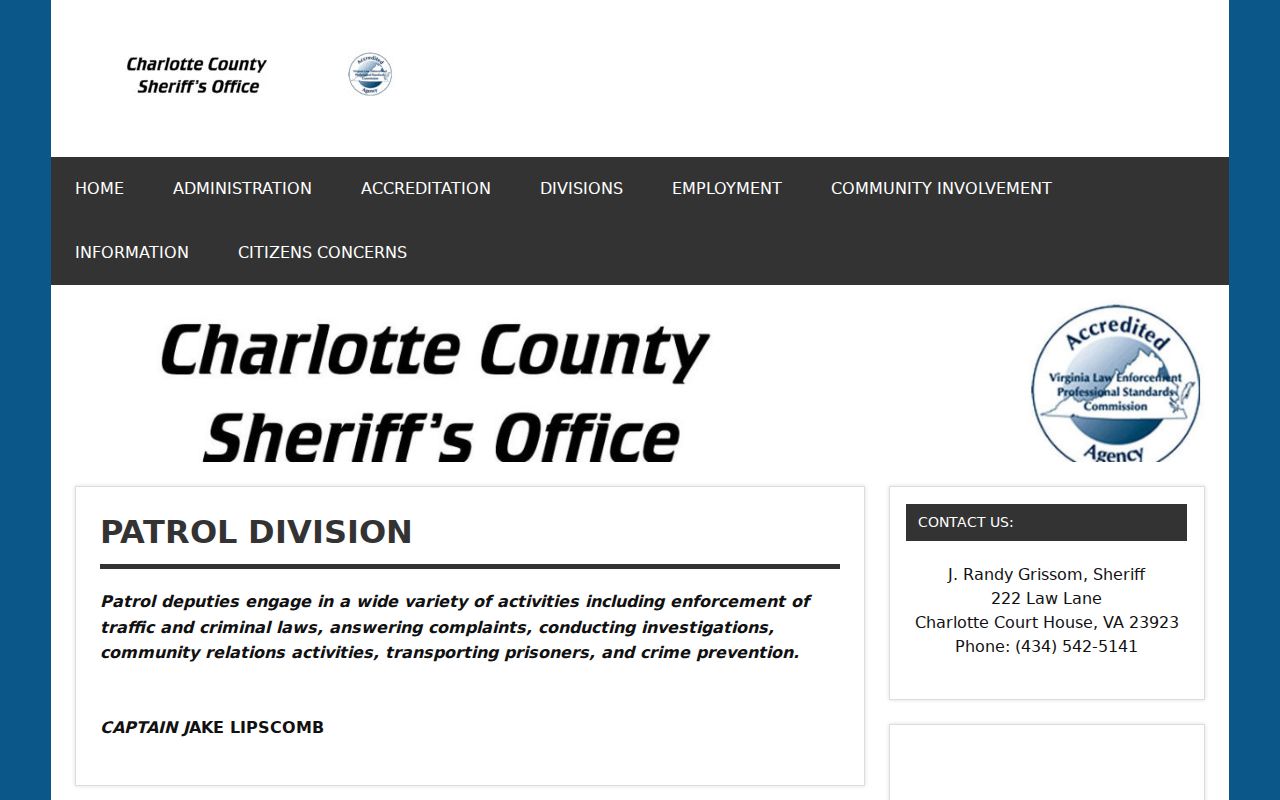
Patrol, transport, investigations, and service are all Sheriff functions. Current warrant status still rests with the issuing court in Charlotte County or the responsible officer.
Who Issues and Serves Charlotte County Warrants
Virginia magistrates examine sworn complaints and decide probable cause for arrest process. Courts issue other process under their rules. In Charlotte County, the Sheriff serves warrants and handles county law-enforcement work, while Virginia State Police provide traffic and investigative support. An issuing judge or clerk and the serving officer simply don't answer the same question.
Charlotte County Sheriff’s Office
222 Law Lane
Charlotte Court House, VA 23923
434-542-5141
The 10th Judicial Circuit map places Charlotte County within its local court structure. A court order may be served beyond the county line under Virginia procedure, so county residence alone doesn't set the reach of process. Use the Sheriff's main number for routing only. The Sheriff's public pages name no dedicated warrant desk and no walk-in status counter.
Charlotte County Court Search Gaps
The online GDC system is a case index, not a live warrant-status service for Charlotte County. It covers adult criminal and traffic matters once a user selects a court. Circuit searches stay locality-specific, and JDR information is limited to protect confidential matters. Federal cases run on a separate federal docket.
- Issued
- A court or magistrate created process.
- Served
- An officer carried out the process.
- Recalled
- The issuing court withdrew the process.
- Capias
- A court order directing that a person be brought before it.
An empty result in a Charlotte County search may mean the wrong court, a record not yet entered, a sealed file, or a different jurisdiction. It does not prove no warrant exists.
What to Do If You Have a Charlotte County Warrant
Start by confirming the paper and the issuing court. Is it a warrant, capias, summons, or show-cause order? A lawyer can weigh whether a motion, new hearing, voluntary appearance, or bond request fits a Charlotte County case. Only the court recalls its process; the Sheriff's Office does not decide that.
Important: Call the official clerk or counsel before appearing. Charlotte’s public sources do not list a universal surrender window, bond counter, or walk-in warrant-clearing schedule.
After any hearing or payment, ask the clerk what order was entered. Then check that the docket actually changed and keep a certified copy. A payment can settle a balance in Charlotte County without closing a pending case, and a recall leaves the full court record intact.
Charlotte County Warrant Payment Plans
Virginia's payment-plan program leaves the details to each local court and points people to the clerk. Charlotte County has a local General District Court policy PDF, though the copy on file is not fully readable. Call the GDC clerk at 434-542-5600 to learn the current deposit, installment terms, fees, and whether a judge must hold a hearing. Signing a payment agreement does not itself recall a capias, so ask the clerk what the plan changes and whether a separate order is required. Current Virginia DMV guidance says courts cannot suspend a license solely for unpaid fines and costs after July 1, 2019. The debt still stands, and separate traffic nonappearance process is not cancelled. Use the Virginia payment-plan program with the Charlotte GDC local policy, and have the clerk explain any term you cannot read before relying on it.
Public Access to Charlotte County Warrant Records
Virginia FOIA covers many executive-branch records, including Sheriff records, but it does not force open every investigative file. Court case records follow separate clerk-access rules. Send a narrow request to the Charlotte County office holding the record, expect lawful redactions or fees, and ask the basis when material is withheld.
Key Rules:
Virginia FOIA, Title 2.2, Chapter 37 covers agency records and exemptions.
Va. Code §2.2-3706 sets rules for law-enforcement records.
Va. Code §16.1-301 protects juvenile law-enforcement records.
For a docket, go through the record-request process at the Circuit, GDC, or JDR clerk. A Sheriff request should describe an existing record, its date range, and its category. Skip the request for a named roster; Charlotte County does not answer warrant checks that way.
Charlotte County Public-Record Requests
Send court-file requests to the clerk of the court that keeps the case. The Virginia Judiciary warns that search and copy costs may apply, and a larger request may need a deposit. A Sheriff request travels a separate FOIA route. Ask for an existing, dated record and request electronic delivery where offered. Do not use the Sheriff's complaint form for a warrant inquiry; it wants an incident and report number and warns against false or misleading statements. The property security-check form has nothing to do with warrant records either. A clear subject line and a narrow date range help a Charlotte County request reach the right person. The Virginia court-record guidance explains the clerk route, and the Virginia FOIA chapter governs the Sheriff's agency records without replacing court access rules.
Warrant Records by City in Charlotte County
The Census and the Virginia directory list four incorporated towns in Charlotte County, not five. Keysville, Drakes Branch, Charlotte Court House, and Phenix run no separate public warrant portals. Town offices handle municipal questions, while warrant process stays with the county courts and Sheriff.
Keysville Warrant Records
2020 population 807 · Town contact is separate from GDC and Sheriff records.
Drakes Branch Warrant Records
2020 population 533 · Countywide court process remains central.
Charlotte Court House Warrant Records
2020 population 505 · Town hall is distinct from the courthouse.
Phenix Warrant Records
2020 population 232 · Sheriff and court clerks are the official routes.